
Build It Yourself, or Have It Built?
Sometimes a website builder is the right answer
If you've got the time and you don't mind doing it yourself, a website builder will get you a website. Plenty of small businesses run on one and do fine.
What the ad doesn't tell you is that the price you see isn't the price you pay, and the work doesn't stop when the site goes live. Updates, edits, the thing that broke on your phone. That's yours now, every month, for as long as you own the site.
That's really the decision here. Not which technology is better, but whether you want a website to run yourself or a website that's handled.
Below is the actual difference, with real prices and a source for every number. Where a builder is the better call, I say so.
What you're actually choosing between
| Website builder (Wix, Squarespace, GoDaddy) | WordPress | Mural City | |
|---|---|---|---|
| What it costs a month | Wix $17–$29; Squarespace from about $19; GoDaddy $9.99 introductory, renewing at $16.99 | $25/mo on WordPress.com to unlock plugins, or hosting plus your own time if self-hosted | $150/mo, $0 down — or a one-time build at $3,500 plus $25/mo hosting |
| What's locked behind a higher plan | Custom domain and ad removal need Wix Light ($17). Selling needs Core ($29). | Plugins and custom themes don't unlock until the Business plan ($25/mo) | Nothing. One price, all of it. |
| Adding a page later | Free — you build it | Free — you build it | $100 per page beyond the five included |
| Who builds it | You do | You, or an agency for a few thousand up front | Sam does. Two to four weeks. |
| Who keeps it current | You do | You do — including plugin updates | Sam does. Unlimited edits to your pages, no per-change charge. |
| Who you call when it breaks | A support queue | Whoever you can find | The person who built it. Phone, text, or email. |
| If you stop paying | Site goes offline or reverts to an ad-supported free tier | Self-hosted: it's yours, if you can host it. WordPress.com: it goes away. | The site comes down. You keep your domain, content, images, and listings. |
| Minimum term | Annual billing to get the advertised price; monthly can run ~41% higher on Wix | Annual billing for the advertised price | None. Cancel any month, no fee. |
| Can you take it with you | No. Wix has no full export; Squarespace only moves between its own versions. | Self-hosted: yes. WordPress.com: content only. | You keep your domain, content, and listings. The code stays with Mural City. |
| Can you sell products online | Yes — on a higher tier, plus transaction fees | Yes | Yes, but it's a separate conversation — a real store is a bigger build, priced in the thousands |
Builder prices are annual-billing rates as published in August 2026 and change often — check the current figure before you decide anything on it. Sources: Wix pricing and GoDaddy pricing (Website Builder Expert, Feb–Mar 2026); WordPress.com pricing. Mural City's own figures are on the pricing page.
What a builder actually costs by year two
The advertised price and the price you end up paying are usually different numbers, and the gap is structural rather than sneaky. Two things drive it.
The tier you need isn't the tier in the ad
Wix's free plan doesn't let you use your own domain and shows ads on your site. To remove both you need the Light plan at $17 a month. To sell anything you need Core at $29. On WordPress.com, the plugins that people actually install WordPress for don't unlock until the Business plan at $25 a month — the $4 and $8 tiers can't install them at all.
Intro pricing renews
GoDaddy's Basic plan is $9.99 a month for the first term and $16.99 after it. Premium goes from $14.99 to $29.99. Commerce goes from $20.99 to $34.99. The free first-year domain renews at around $22.99 a year on its own. This is a pattern across the category rather than one company's trick, and it means the number you compared on isn't the number you'll pay.
Pricing as published August 2026 — Wix, GoDaddy, WordPress.com.You're paying for a person, not a piece of software.
You already pay every month for the things that run your business — payroll, your card reader, insurance, your phone. A website is the one line item still treated like a chore you're supposed to squeeze in on a Sunday.
That's the real difference, and it isn't about code. A builder subscription rents you an editor and hands you the job. Here's what's included instead:
Unlimited edits, with no per-change charge
New hours, a price change, a photo from last week's job, a paragraph you've decided you hate. You send it, it gets done. There's no editor to log into, no layout to fight, and no invoice for fifteen minutes of work.
One price, with nothing gated
No plan to upgrade to get your own domain. No tier that unlocks the feature you assumed was included. The five-page site is $150 a month and that's the number.
A phone number that reaches the person who built your site
Not a ticket queue and not a chatbot. I'm Sam — I'm the designer, the developer, and the person who answers. If something's wrong on a Tuesday morning, you call me and I fix it.
Your Google listing looked at too
A Google Business Profile review and a citation audit are part of the monthly cost. For a local business that shows up in map results before anyone reaches the website, that's sometimes worth more than the site itself.
Nothing to learn, ever
I keep up with browser changes, framework updates, and platform shifts myself, so you never hear about any of it. The hours you'd have spent inside a page builder stay yours.
Where WordPress actually goes wrong
WordPress runs a huge share of the web, and the core software is looked after properly. The problem is the plugins people bolt onto it.
Patchstack counted 11,334 new WordPress vulnerabilities in 2025, up 42% on the year before. 91% of them were in plugins, 9% in themes, and six in WordPress itself. Just under half, 46%, had no fix available on the day they were made public. For the ones attackers actually went after, the gap between disclosure and widespread exploitation ran to roughly five hours.
Wordfence ran its own count with a different method and found 7,966 the year before, 96% of them in plugins. Two companies looking at this independently landed in the same place.
That's a fair reason to think twice about a WordPress site carrying a lot of plugins. It doesn't prove custom code is safer by default, and I won't pretend it does. A badly built custom site has its own problems, and nobody has published a study comparing the two. A site with no plugins does have no plugin vulnerabilities, though, and there's nothing sitting there waiting on you to patch it.
Sources: Patchstack, State of WordPress Security in 2026 · Wordfence 2024 Annual Report. Both companies sell WordPress security products; their findings corroborate each other. These figures describe self-hosted WordPress.org sites, not WordPress.com's managed plans.What happens when you want to leave?
Ask this before you ask anything about design, because it's the one that's expensive to get wrong and the one nobody brings up on a sales call.
On Wix, you can't take it with you. There's no full site export. You can copy your text out and save your images by hand, but the design, the layout, and the code stay on Wix. Leaving means rebuilding.
Squarespace is nearly the same. It can move a site between its own 7.0 and 7.1 versions, losing layout in the process, but there's no supported path to another platform beyond exporting blog text.
Self-hosted WordPress is the exception — the files are genuinely yours and can move to any host. That's a real advantage and it's worth saying so on a page like this one. WordPress.com's hosted plans don't work that way.
And here's mine, since it's only fair. On the monthly plan the site is part of the service. If you cancel, it comes down. You keep your domain, everything you wrote, every photo you supplied, and all your listings and profiles — but not the finished site. The code I write stays mine. I'd rather you read that here than find out later.
What that buys you is the thing nobody else on this page is selling: you don't have to think about your website at all. You don't keep a plan current, you don't apply updates, and you don't chase anyone down when something breaks. You call me and I handle it, for as long as you want me to. And if you ever stop wanting that, you stop paying and we're square. There's no term, no exit fee, nothing to unwind.
Which one is actually right for you
Use a website builder if…
- Building it is something you'd actually enjoy, not something you'd dread.
- You want to change things yourself, at any hour, without asking anyone.
- You're testing an idea and don't know yet whether it'll stick.
- Keeping the monthly cost near $20 matters more than anything else on this page.
Have one built if…
- You'd rather I just handle it: build it, keep it live, and keep it current so it never lands on your list.
- You've started one on a builder and it's still sitting there half-finished.
- You want one person to call, who knows your site because I built it.
- Most of your customers are local and you need to turn up in local search.
- You want it to look like your business, not like a template someone else also picked.
Two sites you can go look at right now
I'm one person and I'm not going to pretend otherwise with a wall of stock badges. These are real businesses running on sites I built. Click them and judge for yourself.
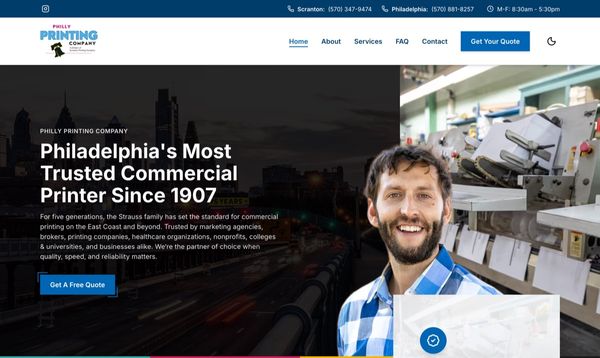
Philly Printing
A commercial printer in Philadelphia that's been family-run since 1907. phillyprinting.com
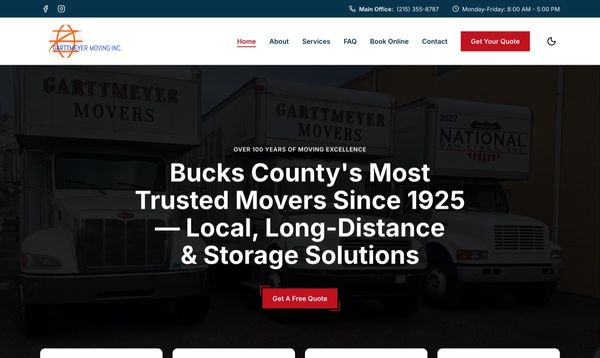
Garttmeyer Movers
A family moving company in Bucks County, moving people since 1925. garttmeyermovers.com
The ones people actually ask
Is a website builder good enough for a small business?
Often, yes. If it's a simple site, you don't mind doing it yourself, and you can spare a few hours a month to keep it current, a builder will do the job. It stops making sense when those hours start costing you more than the price difference, or when you need someone to call.
Why does a custom website cost more than Wix?
You're paying for my time as well as the software. A builder rents you an editor and leaves the work to you. $150 a month covers the building, the hosting, unlimited edits whenever you want them, and someone who picks up the phone. Compare it properly and it's $17 plus your hours against $150 and none of them.
Can I move my Wix or Squarespace site somewhere else later?
Not really. Wix has no full site export. You can copy your text and images out by hand, but the design and the code stay behind. Squarespace only moves between its own versions. Whatever you build on a builder, you rebuild if you leave.
What happens to my website if I stop paying?
On a builder it goes offline or reverts to an ad-supported free tier. On my monthly plan the same is true and it's only fair to say so: the site comes down. You keep your domain, content, images, and Google listings. The code I write stays mine. There's no term and no exit fee. You stop paying and we're square.
Is WordPress insecure?
Core is fine. The plugins are where it goes wrong. Patchstack counted 11,334 new WordPress vulnerabilities in 2025, 91% of them in third-party plugins. Wordfence independently found 96% in plugins the year before. Your exposure is roughly the number of plugins you've installed and how fast they get patched. These figures describe self-hosted WordPress.org sites, not WordPress.com's managed plans.
Do I need to know anything technical to keep a custom site updated?
No. There's no editor to log into and nothing to learn. You email, text, or call with what you want changed and it gets changed. Unlimited edits to existing pages are included.
How long does a custom site take to build?
Two to four weeks, starting from when your content is in hand.
Am I locked into a contract?
No. No minimum term and no cancellation fee. Cancel any month and you owe nothing further.
Can you build me an online store?
Yes, though it's a different conversation. Most of what I build is the kind of site that explains what you do, shows your work, and gets people to call. That's the $150 a month offer. A real store has payments, inventory, and integrations behind it, so it's a bigger build, priced in the thousands, with more ongoing upkeep. If that's genuinely what you need, tell me and we'll scope it. If you're not sure yet, a builder is a reasonable place to start and I'll say so.

Web Design That’s Fast, Affordable, and Built for Results.
High quality solutions for small businesses that deliver big results.
Get in Touch!